
How to Read Mahjong Discards: Discard River Pattern Analysis
What Is the Discard River in Mahjong?
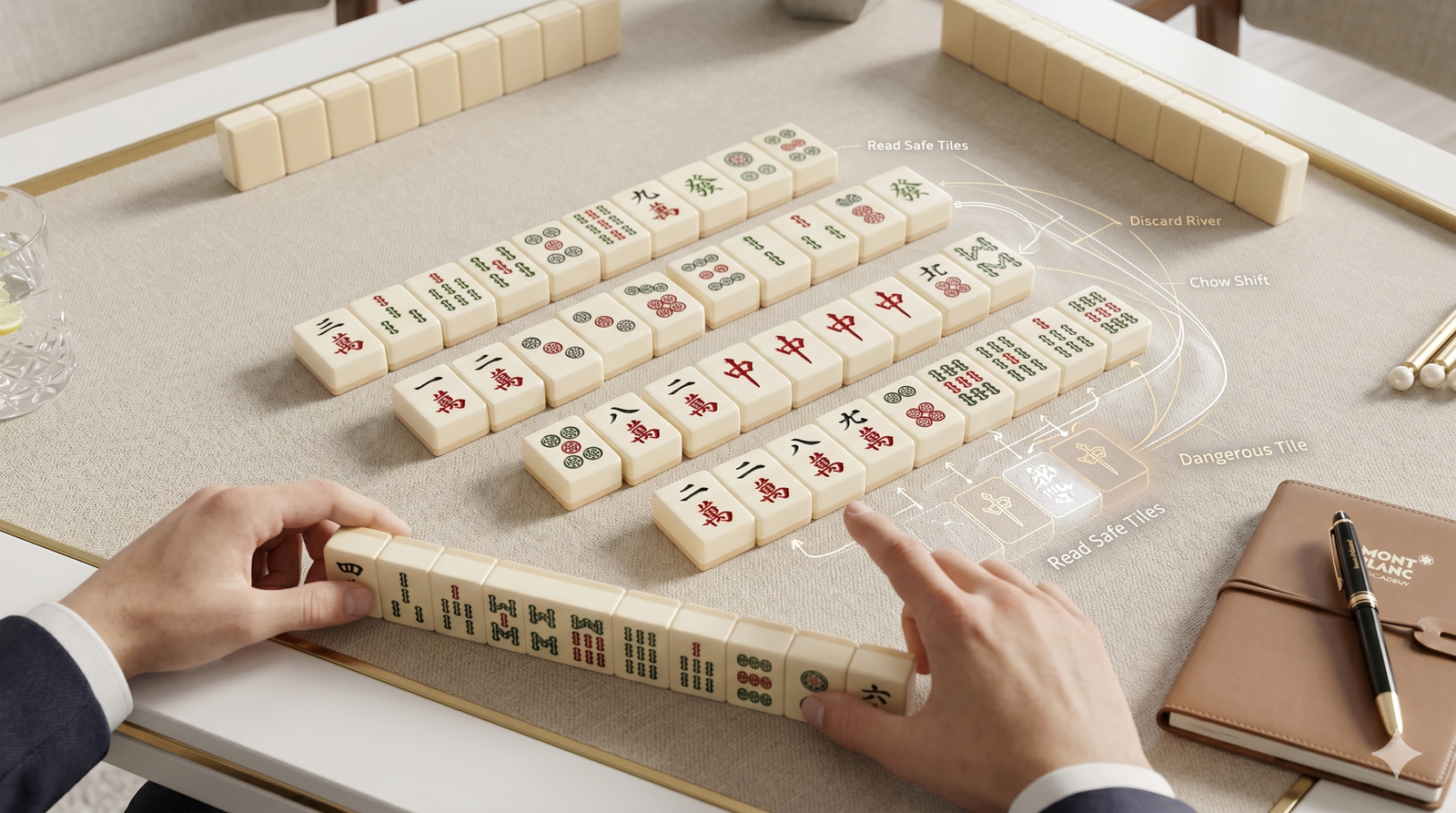
Learning how to read mahjong discards is one of the highest-leverage skills you can develop as a player. The discard river — also called the discard pool — is the arrangement of tiles each player has thrown away during a game. Every player’s discards are laid out in front of them in the order they were discarded, forming a visual record of every decision they have made since the game began.
Most beginners look at the discard river and see noise. Intermediate players look at it and see a story.
Learning to read that story is one of the highest-leverage skills you can develop as a Mahjong player. It does not require memory tricks or advanced math. It requires pattern recognition — and a framework for knowing what to look for.
Why Discard River Analysis Matters
In Mahjong, unlike digital versions of the game, there is no computer assistant telling you which tiles are safe. You are on your own.
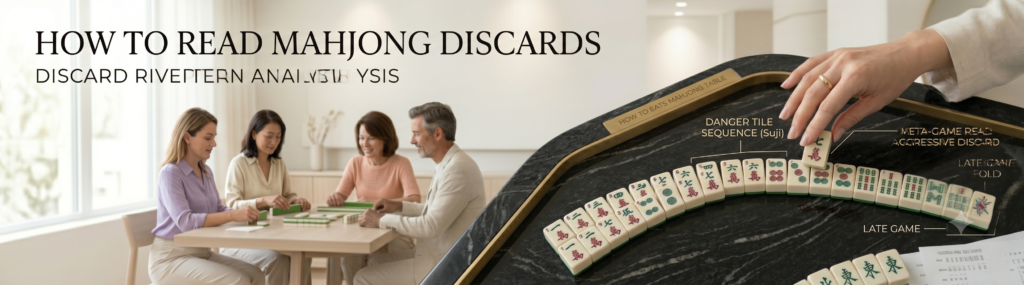
Every tile your opponent discards is a data point. Over the course of 10 to 15 discards, those data points form a pattern that reveals what kind of hand your opponent is building — and by extension, which tiles are dangerous for you to throw and which ones are safe.
Without discard river analysis, you are playing blind. With it, you are playing with a significant informational advantage.
The Three Questions to Ask Every Turn
Before reading specific patterns, train yourself to ask three questions every time you study an opponent’s river:
1. What suits are missing from their discards?
If an opponent has thrown away almost no Bamboo tiles, they are likely keeping Bamboo. That tells you their hand is built around Bamboo — and Bamboo tiles are dangerous to discard into them.
2. When did the pattern change?
Early discards reveal what a player started with. Later discards reveal what they decided to commit to. A sudden shift in what they are throwing — for example, switching from discarding honor tiles to discarding number tiles — signals a hand change or a draw that redirected their strategy.
3. Are they throwing isolated tiles or pairs?
A player discarding lone tiles from multiple suits is typically building a flexible, sequence-based hand (Chow hand). A player discarding pairs or tiles that appear to complete sequences suggests they are shifting toward a Pung-heavy or single-suit hand. This distinction is critical for defensive play.
How to Spot a Single-Suit Hand in Progress
A single-suit hand — where a player commits to only Bamboo, only Characters, or only Circles — is one of the most dangerous hands to play into.
Signal 1: Early discard of honor tiles and winds
Almost every player discards winds and honor tiles in the first few turns. But if an opponent has discarded all of their honors early AND begins discarding tiles from two out of three suits, they are almost certainly consolidating into the remaining suit.
Example of a suspicious early river — all honors and mixed suits discarded, Bamboo conspicuously absent:





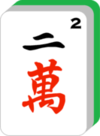

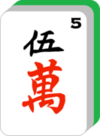
Eight discards, no Bamboo at all. Bamboo is dangerous to throw against this player.
Signal 2: Mid-game discards of connector tiles
Connector tiles are middle tiles — 4s, 5s, and 6s — that are valuable precisely because they connect to so many sequences. A player discarding these mid-game is not building sequences.
Example of a mid-game river signaling a Pung or single-suit hand:


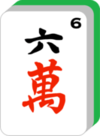


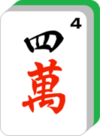
Notice the 4s, 5s, and 6s being thrown away across multiple suits. This player is not building Chows — they are clearing connectors for a Pung-based or single-suit hand.
Signal 3: Discards cluster at the edges of a suit
If you see a player throwing 1s and 9s of a particular suit, they are keeping the middle tiles of that suit. This is a classic sign of a high-value single-suit hand in the making.
Example river showing edge tiles being discarded from Circles:



Both 1-Circle and 9-Circle appearing twice. The middle Circles — 3 through 7 — are being kept. Circles are dangerous to discard against this player.
Reading the Chow-to-Pung Shift
One of the most important patterns to recognize is when an opponent transitions from building a Chow-based hand to a Pung-based hand.
In the early game, most players default toward sequence building. A player in this mode will discard honor tiles, isolated tiles, and tiles that do not fit into any sequence.
Early river — typical Chow-building pattern:

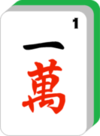

Honors and terminal tiles discarded early. Normal Chow-building behavior. Nothing alarming yet.
Mid-game river — Pung hand shift detected:

Now connector tiles are appearing — 4-Circle, 5-Bamboo, 6-Characters. This player changed strategy. They are no longer building sequences. The hand has shifted toward Pungs or a single suit. Any tile from their kept suit is now high risk.
Tracking Dead Tiles: The Defensive Framework
A dead tile is any tile that has already appeared enough times in the game that it cannot possibly complete anyone’s hand. Tracking dead tiles is the foundation of safe defensive discarding.
There are four copies of every tile in a standard set. When you see three or four of the same tile already discarded or melded, that tile is dead. You can discard it safely.
Example — 7-Bamboo is dead:

Three 7-Bamboo tiles already visible in rivers and melds. The fourth copy in your hand is completely safe to discard. No one can Pung it.
Example — 5-Circle is semi-dangerous:
Two 5-Circle tiles already out. Someone may still hold the third and fourth copies and be waiting for a Pung. Treat with caution.
The practical habit: Before discarding, scan the rivers quickly for the tile you are about to throw. If it has already appeared two or three times publicly, your risk drops significantly.
Pattern: The Danger Signals Late in the Game
As the game progresses into the second half — roughly after turn 10 — the discard river analysis becomes more urgent.
Consecutive number discards from one suit are a warning sign.
A player discarding 3-Bamboo, then 6-Bamboo, then 9-Bamboo in close succession is likely clearing non-essential tiles from a Bamboo hand:


These three discards in sequence tell you the player is keeping specific Bamboo tiles — likely a cluster around 4, 5, 7, or 8-Bamboo. Those tiles are dangerous to throw.
Honor tile discards late in the game are suspicious.
Most players discard honors in the first three to five turns. If someone discards an honor tile on turn 12:
That Green Dragon discard on turn 12 is unusual. Either they picked it up late from the wall, or they changed their hand strategy entirely. Pay close attention to what they discard next.
Practical Drill: Reading a River in 10 Seconds
When it is your turn to discard, use this 10-second scanning method on each opponent:
- Suits (3 seconds) — which suits appear most in their river? Which are absent?
- Sequence vs. triplet signals (3 seconds) — are they discarding connectors, pairs, or random isolated tiles?
- Dead tile check (4 seconds) — for the tile you are about to discard, how many copies are already visible?
This does not require perfect tracking. It requires building the habit of looking before you throw.
Common Mistakes in Discard River Reading
Mistake 1: Reading only one opponent’s river Focus on the player to your right first — they discard immediately before you and are most likely to affect your next turn. Then check the player across from you. The player to your left is least urgent but still worth a glance.
Mistake 2: Assuming early discards predict late behavior Players change strategies when they draw pivotal tiles. A player who looked like they were building a Chow hand in turns 1 through 6 may have drawn a pair that redirected them toward a Pung hand by turn 8. The river tells you history, not destiny.
Mistake 3: Over-weighting a single tile One unusual discard does not tell you much. Three unusual discards in a row tell you everything. Look for the pattern, not the individual tile.
Mistake 4: Ignoring your own discard tells Your river is visible to everyone at the table. Skilled opponents are reading your pattern the same way you are reading theirs. Be aware of what your discards are communicating.
Key Takeaways
- The discard river is a sequential record of every decision your opponent has made. Read it as a timeline, not a pile.
- Absent suits in a river are often more informative than present ones — what a player is NOT throwing tells you what they are keeping.
- The shift from Chow building to Pung building is visible in the river if you know the signals: connector discards, suit consolidation, and specific tile clustering.
- Dead tile tracking is the most reliable defensive tool available. Use it every turn before you discard.
- Develop the 10-second scan habit so that reading the river becomes automatic rather than effortful.
Frequently Asked Questions
How many discards do I need to see before I can read a pattern?
Three to five discards from a single opponent is usually enough to begin forming a hypothesis. By seven to eight discards, you should have a clear read on their suit focus and hand type.
What if an opponent discards in a way that seems random?
Randomness in discards usually means one of three things: the player is a beginner with no clear strategy, the player is deliberately trying to conceal their hand, or the player changed strategies mid-game. If the randomness continues past turn 8, lean toward beginner-level unpredictability and focus your defensive attention on the other two players.
Does discard river analysis work the same in all versions of Mahjong?
The core principles apply to all Mahjong variants — Cantonese, Hong Kong Old Style, and Riichi Mahjong all use a visible discard river. The specific hand types you are watching for vary by ruleset, but the pattern-reading framework remains the same.
How do I get faster at reading the river?
Play more games with deliberate attention to rivers. After each game, spend two minutes reviewing what the discard rivers told you and compare it to what hands your opponents actually had. The feedback loop accelerates the learning dramatically.
This article is part of the HeyMahjong Intermediate Strategy Series. If you want to practice applying discard river analysis in real time, try the HeyMahjong AI Coach — it gives you instant feedback on your discard decisions based on the live game state.
Ready to go deeper? Explore our full Learning Path at learn.heymahjong.com.