Mahjong Rules: 7 Simple Rules Every Beginner Must Know
Introduction
Mahjong rules explain how players build winning hands by drawing and discarding tiles while forming specific combinations. Mahjong is a four-player strategy game that combines pattern recognition, probability, and observation.
Although Mahjong has several regional variations, the core Mahjong rules remain largely the same. Players draw tiles, form sets, and attempt to complete a winning hand before the other players.
How Many Players Are in Mahjong?
Mahjong is played with four players. Each player sits at one of four seats — East, South, West, and North — and takes turns drawing and discarding tiles until someone completes a winning hand.
While four players is the standard for most Mahjong variants (including Chinese, Japanese Riichi, and American Mahjong), some house rules or informal games allow three players by removing one suit from play. Four players remains the most common and widely recommended way to play.
If you are new to the game, you may also want to read the guide explaining how to play Mahjong for beginners to understand the basic gameplay structure.
Mahjong Rules for Beginners
Mahjong rules for beginners focus on three important ideas: the structure of a winning hand, the flow of turns during the game, and the tile combinations used to build sets.
Most Mahjong games follow the same basic principle. Players build four sets and one pair while drawing and discarding tiles throughout the round.
Once beginners understand the structure of a winning hand and the flow of gameplay, the rest of the Mahjong rules become much easier to follow.
Rule 1: A Winning Hand Contains Four Sets and One Pair
The most important Mahjong rule is understanding the structure of a winning hand.
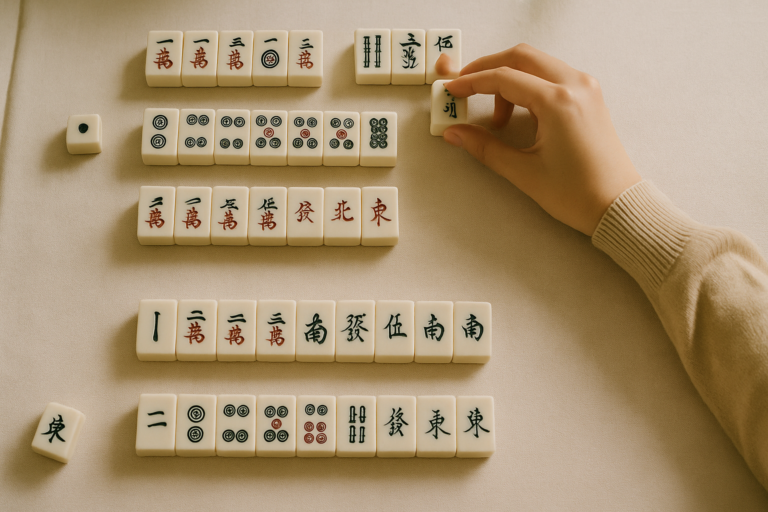
To win in Mahjong, a player must build a hand containing four sets and one pair.
A set usually contains three tiles and can be:
• a sequence
• a triplet
• a kong
A pair contains two identical tiles.
Example winning hand:











Once a player completes four sets and one pair, they declare Mahjong and win the round.
Rule 2: Determine the Dealer and Seating
Before the game begins, players must determine the dealer and seating positions.
Each player rolls the dice. The player who rolls the largest number becomes the dealer.
The dealer then selects a seat and becomes the East player. The remaining players take the South, West, and North seats around the table.
These seat positions remain important throughout the Mahjong game.
Rule 3: Decide Where to Break the Wall
After the tiles are shuffled and the walls are built, the dealer rolls the dice again.
The dice number determines where the wall will be broken.
Counting begins from the dealer’s wall and continues counter-clockwise around the table. The counted position determines where the wall is separated and where players begin drawing tiles.
This step determines the starting point of the tile draw.
Rule 4: Build Mahjong Tile Sets
Mahjong rules require players to form sets using tile combinations.
Common sets include:
Sequence
Triplet
Quad
These sets form the structure used to complete a winning hand.
Rule 5: Understand Mahjong Actions (Chi, Pong, Kong)
Mahjong rules allow players to claim tiles discarded by other players to complete sets.
The three main actions are Chi, Pong, and Kong.
Chi
Chi means claiming a discarded tile to complete a sequence.
Example:
If you already have:
and the player on your left before you discards:
you may call Chi.
Chi can only be called from the player immediately before you.
Pong
Pong means claiming a discarded tile to complete a triplet.
Example:
If another player discards:
and you already have:
you may call Pong.
Pong can be called from any player’s discard.
Kong
A Kong is a four-tile set.
Example:
There are several types of Kong.
Exposed Kong
You already have three identical tiles and claim the fourth tile from another player’s discard.
Concealed Kong
You draw the fourth tile yourself while holding the other three.
Added Kong
You previously declared a Pong and later draw the fourth tile.
Rule 6: Always Draw Before You Discard
One of the most important Mahjong rules beginners must remember is that every turn begins with drawing a tile.
Each turn follows the same sequence:
• draw one tile
• decide which tile to discard
• place the discarded tile face up
If a player discards before drawing, they will have one tile fewer than the other players and will not be able to complete a winning hand.
Rule 7: Watch the Table and Understand the Flow of the Game
Mahjong is not only about your tiles. Players should always watch the entire table and pay attention to what other players discard.
Observing the table helps players understand which tiles are still available and prevents helping opponents complete their hands.
A Mahjong round follows a repeating flow:
- each player starts with 13 tiles (dealer has 14)
- the dealer discards one tile to begin the round
- players take turns drawing and discarding tiles
- players may call Chi, Pong, or Kong
- players build sets and improve their hands
- when a player completes four sets and one pair, they declare Mahjong and win the round
Understanding this flow makes Mahjong rules easier for beginners to follow.
Mahjong Rules Summary
The basic Mahjong rules can be summarized as follows:
• Mahjong is played with four players
• the dealer is determined by rolling the dice
• the dealer rolls again to decide where the wall is broken
• players build four sets and one pair to win
• players draw and discard tiles each turn
• players may claim tiles using Chi, Pong, or Kong
• observing the table helps improve strategy
These Mahjong rules form the foundation of most Mahjong games played around the world.
Learn Mahjong Faster with a Cheat Sheet
Download the Free Mahjong Cheat Sheet to quickly learn the tiles, basic hands, and beginner strategies.
Continue Learning with Mahjong Academy
For structured lessons, deeper strategy explanations, and guided practice, explore the Mahjong Academy.