How to Practice Mahjong Without Pressure
How to practice Mahjong without pressure is a question many players quietly carry with them, even if they never voice it. Practicing is often assumed to be fast, competitive, or public, and for many, that assumption becomes the very reason they hesitate to practice at all. Yet Mahjong, at its core, has always allowed for a quieter approach — one that values clarity over speed and understanding over outcome.
Learning how to practice Mahjong begins with a shift in perspective. Practice is not about completing hands as efficiently as possible. It is about noticing patterns, observing choices, and allowing understanding to develop gradually, without the expectation of performance.
Practice is not the same as play
In many modern settings, Mahjong is introduced through play. Hands are completed, tiles are claimed quickly, and attention moves forward without pause. While play has its place, it is not always the most effective way to learn.
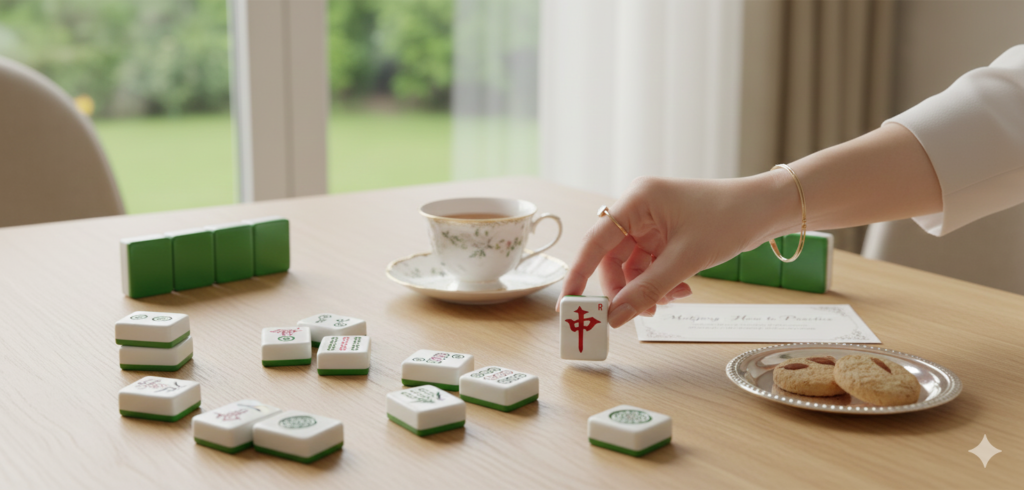
Practice, by contrast, creates space. It slows the experience down. It allows a player to remain with a decision long enough to understand why it matters. Without the urgency of winning or keeping pace with others, practice becomes an opportunity to reflect rather than perform.
Mahjong has long been understood as a game of observation and decision-making, a role it has held across cultures and generations. This historical emphasis on attention rather than speed is what makes thoughtful practice possible.
Understanding how to practice Mahjong without pressure often begins by separating these two experiences. Play asks for momentum. Practice asks for awareness.
Starting with one decision at a time
One of the simplest ways to practice Mahjong without pressure is to narrow the focus. Instead of trying to manage every possible outcome, practice can begin with a single decision: what to let go.
Discarding is often treated as a reflex, something done quickly to keep the game moving. In practice, it deserves more attention. Each discard shapes the hand that follows. Each choice reveals priorities, assumptions, and habits that might otherwise go unnoticed.
When players practice Mahjong by slowing down the discard process, they begin to see patterns more clearly. Over time, this focused approach builds confidence — not through repetition alone, but through understanding.
Creating space for learning
Pressure often enters Mahjong through comparison. Watching others play faster. Feeling behind. Worrying about making the wrong move. Practicing privately or in a guided environment removes these signals and replaces them with space.
When learning how to practice Mahjong in this way, mistakes lose their weight. They are no longer interruptions or embarrassments. They become information — quiet indicators of where attention can settle next.
This kind of practice supports consistency. Instead of avoiding practice because it feels demanding, players return to it because it feels manageable. Learning accumulates naturally, without forcing progress.
Practice as a personal rhythm
There is no single correct pace for practicing Mahjong. Some days allow for deeper focus. Others invite only a few quiet hands. Both are valid.
Approaching Mahjong practice as a personal rhythm — rather than a task to complete — helps sustain learning over time. It also aligns more closely with how Mahjong has traditionally been experienced: as something integrated into daily life, not separated from it.
Understanding how to practice Mahjong without pressure means accepting that improvement is often subtle. It appears not as sudden mastery, but as calmer decisions, clearer judgment, and a growing comfort with uncertainty.
Returning with intention
Ultimately, learning how to practice Mahjong without pressure comes down to intention. Choosing when to pause. Deciding what to observe. Allowing understanding to develop without forcing it.
For those interested in learning Mahjong in a modern context, exploring approaches that emphasize guided, thoughtful practice can offer a calmer entry point.
Mahjong does not demand urgency. It rewards attention. And when practiced without pressure, it becomes not only easier to learn, but easier to return to — one decision at a time.